
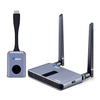
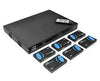
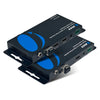

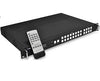



Modern AV setups demand more than just high-definition visuals, they require flexibility, scalability, and reliable long-distance transmission. Whether for conference rooms, digital signage, classrooms, or large-scale control centers, the ability to distribute high-quality video and audio efficiently has become essential.
Two leading technologies dominate this space: AV over IP and HDMI over HDBaseT. Both offer powerful AV over IP solutions but differ significantly in how they deliver content, how far they reach, and how easily they scale. This guide breaks down their key differences to help you decide which technology fits your setup best.
What Is AV over IP?
AV over IP, also known as HDMI to IP, transmits HDMI signals through standard network infrastructure rather than traditional HDMI cables. Using a 4K IP encoder and decoder, the system converts the video signal into data packets that travel through your Av over IP network.
Key Features:
-
Scalability: You can easily expand the setup by adding more transmitters and receivers to the network, making HDMI over IP 4K systems ideal for large installations.
-
Flexibility: Supports various resolutions and formats, including 4K and even 8K, across multiple displays.
-
Network Integration: Works seamlessly over existing Ethernet networks, eliminating the need for special cabling.
With an AV over IP extender, it’s possible to transmit signals over long distances, making it a strong option for multi-room or building-wide installations.
What Is HDBaseT?
HDBaseT is a connectivity standard that sends uncompressed HDMI signals over a single Cat5e or Cat6 cable. It transmits video, audio, Ethernet, power, and control signals, creating what’s known as the “5Play” feature set.
Key Features:
-
Long-distance Transmission: Capable of delivering full-quality video up to 100 meters over one cable.
-
Uncompressed Signal: Maintains original video and audio quality with zero compression.
-
Power over HDBaseT (PoH): Sends power through the same cable, reducing clutter and the need for extra power adapters.
This makes HDMI over HDBaseT ideal for straightforward, point-to-point connections such as connecting a source device to a display or projector in a meeting room or classroom.
AV over IP vs. HDBaseT: A Comparative Overview
The table below compares AV over IP and HDBaseT technologies across key features, helping you choose the best option for your setup.
| Feature | AV over IP | HDBaseT |
|---|---|---|
| Transmission Distance | Extends signals over existing network infrastructure; range depends on network quality and design. Ideal for multi-room or building-wide setups. | Transmits up to 100 meters over a single Cat5e/Cat6 cable. Reliable for shorter, direct connections. |
| Signal Compression | May involve compression (e.g., H.264 or H.265) | Uncompressed signal transmission |
| Scalability | Very high – easily add or remove displays through the network without major rewiring. | Moderate – adding endpoints typically requires extra transmitters, receivers, and cabling. |
| Ease of Setup | Requires basic network setup and configuration, especially for larger systems. | Simpler, plug-and-play installation with minimal setup. |
| Cost | Potentially higher due to network switches and configuration | Generally lower; fewer components needed |
| Ideal Use Cases | Best for large-scale or multi-zone installations such as campuses, hotels, or control centers. | Suited for straightforward, point-to-point connections like classrooms, conference rooms, or home theatres. |
In summary, if your setup involves many displays across different rooms or buildings, ToVi AV over IP is the smarter choice as it scales easily and integrates with your existing network. For smaller setups or direct connections where reliability and simplicity are priorities, HDBaseT Extenders delivers excellent results with minimal setup. You can also use the guide below to help you choose which technology to use:
Choosing the Right Solution
Selecting between AV over IP and HDBaseT can also depend on several factors:
-
Distance Requirements: For single-room or short-range setups, HDBaseT’s 100-meter capability works perfectly. For longer runs, go over IP for greater reach.
-
Scalability Needs: AV over IP offers unmatched flexibility, ideal for expanding systems or multi-zone environments.
-
Budget Constraints: HDBaseT systems tend to be more cost-effective for straightforward point-to-point use.
-
Infrastructure: Consider your existing network. If you already have a strong Ethernet setup, HDMI to IP solutions can leverage it efficiently
If you are connecting a single media source to a single display or a number of media sources to multiple displays (matrix) and you know that you do not need more, then HDBaseT Extenders would be the best cost effective solution. However, if you have a requirement where you may add more endpoints, be it sources or displays, OR you cannot do direct cabling and have to go through a network infrastructure, go with ToVi AV over IP.
Introducing ToVi – OREI’s Next Step in Professional AV Over IP
ToVi is a dedicated sub-brand from OREI, created to deliver advanced AV Over IP solutions built for modern professional environments. It’s designed for system integrators, commercial installers, and organizations that need scalable, flexible, and strong AV distribution. Whether you’re putting together a corporate video wall, a control room, or a multi-zone display network, ToVi gives you the power to move audio and video across standard IP networks with ease and reliability.
If you want to see how AV Over IP can transform your next project, explore ToVi here.
AV over IP vs HDBaseT
Both AV over IP and HDBaseT provide dependable ways to distribute video and audio signals, but they serve different needs. AV over IP extenders shine in large, flexible environments where scalability and reach are key, while hdmi base t remains a go-to for straightforward, high-quality, short-distance connections.
If you have any questions or need help selecting the right product for your needs, feel free to reach out to our support team at info@orei.com or if you would like help designing your setup, reach out to our Design Assistance team by filling out this form: https://www.orei.com/pages/project-design-assistance"