
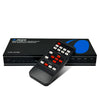
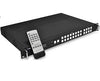


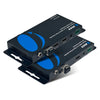


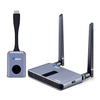




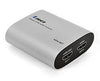



Adding a second TV is usually easy. The challenge starts when the same content needs to appear throughout a restaurant, retail store, office, church, or waiting room.
Sports broadcasts, digital signage, presentations, and announcements often need to reach multiple displays at once. As distances increase, running individual HDMI cables to every screen becomes less practical. OREI HDMI extender splitters and AV over IP solutions help businesses distribute content across multiple displays while supporting different installation sizes and future growth requirements.
What Is an HDMI Extender Splitter?

Restaurants, churches, and retail stores often need the same content displayed farther than a practical HDMI cable run allows.
An HDMI splitter and extender combines HDMI splitting and HDMI extension over CAT5e or CAT6 cabling. These systems are also commonly described as an HDMI splitter over ethernet or HDMI extender over CAT6, using structured cabling instead of long HDMI runs.
Many businesses use an HDMI splitter for multiple TVs to distribute the same content throughout a facility. OREI HDMI Extender Splitter solutions are commonly used when display counts are fixed and future expansion is unlikely.
Why Businesses Choose HDMI Extender Splitters
Not every deployment needs advanced routing or centralized management. Restaurants, churches, help desks, data centers, and test bench facilities often need the same content displayed across multiple screens. An HDMI extender splitter 1x2 is a common choice for mirroring a source to two displays, while larger configurations support additional screens.
These systems offer plug-and-play deployment, reliable long-range transmission, and support for high-resolution video, including 4K HDMI over CAT 6.
Common Business Use Cases for HDMI Extender Splitters
Walk into a sports bar during a major game and you'll often see the same broadcast playing across multiple TVs.
The same principle applies elsewhere. Retail stores use shared promotional content across displays. Churches mirror presentations into overflow rooms. Offices distribute presentations to multiple meeting spaces, while waiting rooms display information and announcements.
Using CAT cabling makes these installations easier when displays are spread throughout a facility.
Benefits of Using CAT Cables Instead of Long HDMI Runs
The farther a display gets from the source, the more limiting HDMI cables become.
Many businesses prefer HDMI splitter over ethernet solutions because CAT5e and CAT6 cabling supports longer transmission distances while being easier to route. They also simplify cable management and provide more reliable signal stability over distance, which is why it’s often preferred in commercial AV installations.
When HDMI Extender Splitters May Not Be Enough
Most HDMI extender splitters are designed around fixed display counts and mirrored content.
That works for many environments, but it becomes limiting when businesses need independent content routing, video walls, centralized management, or expansion across multiple floors. Those requirements often push organizations toward AV over IP.
AV over IP: The Next Step for Growing Businesses

A few displays are easy to manage. But adding more rooms, departments, or floors creates new challenges. An AV over IP system distributes video through a standard Ethernet network using an encoder → network switch → decoder workflow.
Instead of being limited by fixed outputs, businesses can add endpoints as needed. Different displays can show different content, video walls become possible, and management is centralized.
OREI ToVi AV over IP solutions include Web GUI control, centralized management tools, managed switch deployment, and scalable network architecture. For businesses planning long-term growth, that flexibility can be difficult to achieve with traditional extender splitters.
Comparison Table: HDMI Extender Splitter vs AV over IP
Real-World Example: Mission-Critical AV over IP Deployment
The Franklin County Emergency Management Agency needed to bring live information from multiple locations into a centralized Emergency Operations Center. Traditional video wall solutions exceeded the project's budget.
The agency deployed the OREI ToVi X4 Series and later expanded the system by adding encoders rather than replacing infrastructure. The AV over IP deployment delivers 4K video distribution, USB KVM support, scalable multi-display architecture, and centralized monitoring.
See the real-world deployment in this ToVi Emergency Operations Center Case Study Video:
Need Help Designing Your AV System?
OREI's Free Design Assistance service helps businesses with product recommendations, AV system planning, network mapping, and deployment guidance.
Request expert guidance now through the Free Design Assistance Request Form.
Choosing the Right Multi-TV Distribution Solution
HDMI extender splitters are an excellent fit for businesses that need simple distribution to a fixed number of displays. AV over IP offers greater flexibility for organizations planning future growth, independent content routing, or centralized management.
OREI provides reliable solutions for both straightforward multi-TV deployments and large-scale AV networks.