
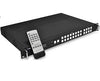












A conference room with two displays is easy to wire. Add meeting rooms, digital signage, control spaces, and displays across multiple floors, and the same approach quickly becomes harder to manage.
Modern organizations depend on connected AV systems to support communication, collaboration, and information sharing. HDMI extenders and AV over IP are both designed to distribute content over longer distances, but they scale very differently. Understanding those differences can help businesses choose commercial AV solutions that continue to support growth instead of limiting it.
What Is an HDMI Extender?

A standard HDMI cable works well until the display ends up on the other side of the room. That’s when you use an HDMI extender.
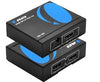
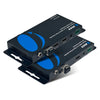
An extender carries HDMI signals over CAT6 or CAT7 cabling using a transmitter (TX) at the source and a receiver (RX) at the display. You'll also see this arrangement often described as an HDMI receiver and transmitter system or HDMI over Ethernet solution. It provides reliable point-to-point distribution without relying on long HDMI cable runs.
Conference room AV installations, classrooms, retail environments, and houses of worship commonly use an HDMI wire extender when displays remain in fixed locations. OREI HDMI extender solutions are built for these straightforward deployments.
What Is AV Over IP?

An extender can take you farther than standard HDMI cables, but the conversation changes once displays start spreading across buildings instead of rooms.
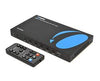
Rather than creating a dedicated cable path for every display, AV over IP distributes audio and video through a standard Ethernet network. An AV over IP encoder or 4K IP encoder sends the source to a managed network switch, where it can be routed to decoders throughout the system.
OREI ToVi AV over IP solutions use this network-based architecture to simplify multi-display deployments while making future expansion far easier than traditional point-to-point systems.
The Biggest Difference: Point-to-Point vs Network-Based Distribution
HDMI Extenders create a direct connection between the source and the display. Add another screen, and you'll typically add another receiver, another cable, and additional hardware.
AV over IP works differently. Once sources enter the IP network, managed switches can route any source to any connected display. The same infrastructure also supports multicast distribution without creating separate cable runs for every endpoint.
That network-based approach gives growing businesses much more flexibility as requirements change.
Why HDMI Extenders Become Limited at Scale
As mentioned earlier, extenders work well until the number of displays starts growing.
New displays require another receiver, another cable run, and additional hardware to install and maintain. Add too much and rack space fills up, cable management becomes harder, and expanding into new rooms or floors often means revising the existing infrastructure.
But those trade-offs don't make extenders a poor choice. They simply make them better suited to installations where layouts are unlikely to change.
How AV Over IP Makes Expansion Easier
Expanding an AV over IP system means adding endpoints instead of redesigning the entire installation.
Displays can be added through the existing network without major rewiring, making expansion across multiple floors or buildings more practical. Businesses also gain flexible routing, centralized management, and support for video walls without rebuilding the underlying infrastructure.
OREI ToVi AV over IP solutions include Web GUI management, a centralized control hub, managed switch architecture, PoE-enabled deployment, and video wall capabilities. Together, these features make ToVi a strong fit for enterprise environments that expect continued growth.
Remote Management and Centralized Control
Managing one room is very different from managing dozens. Most HDMI extender deployments require local access whenever equipment needs configuration or maintenance.
AV over IP allows administrators to manage transmitters and receivers through a browser-based interface. OREI ToVi systems include a Web GUI and centralized control box, making firmware updates, routing changes, and system monitoring easier across large deployments.
Comparison Table: HDMI Extenders vs AV Over IP
|
Feature |
HDMI Extenders |
AV Over IP |
| Infrastructure | Point-to-point CAT cable | Standard network infrastructure |
| Scalability | Limited | Highly scalable |
| Routing Flexibility | Limited | Any source to any display |
| Multi-Building Support | Difficult | Easy |
| Centralized Management | Minimal | Advanced |
| Video Wall Support | Limited | Yes |
| Remote Configuration | Limited | Web GUI / centralized control |
| Best For | Small-to-medium setups | Growing enterprise deployments |
Real-World Applications Where AV Over IP Excels

With AV over IP, corporate offices can route content between multiple meeting rooms without dedicated cable paths. Universities and campuses can manage digital signages from a central location. Control rooms, operations centers, hospitality venues, and retail chains can all expand displays over time without redesigning the entire system.
For organizations planning long-term growth, this flexibility makes AV over IP one of the most practical commercial audio visual solutions available.
Need Help Designing Your AV System?
Building a scalable AV system starts with the right design. OREI's Free Design Assistance service helps businesses with network mapping, product recommendations, system planning, and deployment guidance.
Businesses planning scalable AV deployments can request expert guidance through OREI's Free Design Assistance Request Form.
Building an AV System That Can Grow with Your Business
HDMI extenders remain a dependable choice for smaller point-to-point installations where expansion is limited.
For organizations planning larger deployments, AV over IP provides the flexibility, centralized management, and scalability needed to support future growth. OREI ToVi AV over IP solutions help businesses build infrastructure that can expand alongside their communication needs.